 1 / 4
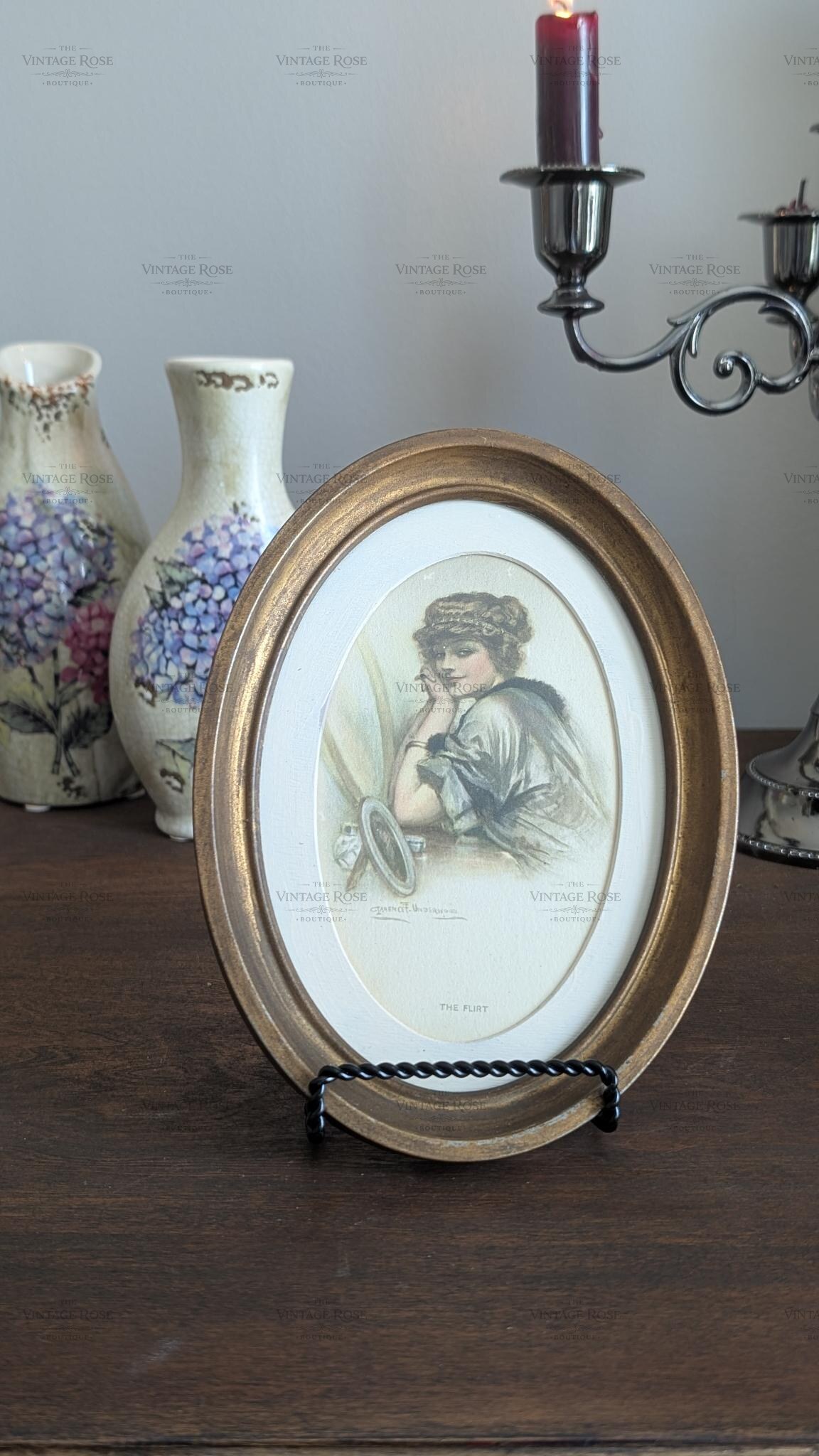
The Flirt — Clarence F. Underwood Framed Plate Illustration, c. 1913 Edwardian Portrait
Price in USD. Shipping is $10.95 to the contiguous US — see our Shipping Policy.
Details
- Artist: Clarence Frederick Underwood (1871–1929)
- Title: "The Flirt"
- Source: Likely a plate illustration from the 1913 first edition of The Flirt by Booth Tarkington (Doubleday, Page & Co.)
- Medium: Printed book plate illustration
- Frame: Oval gold-tone frame with oval mat
- Dimensions: 7.5″ H x 5.5″ W (framed)
- Signed: "Clarence F. Underwood" printed below the image
- Provenance: From the personal collection of a 94-year-old woman
Condition
Good vintage condition. The print shows age-appropriate toning consistent with paper over a century old. The oval gold-tone frame displays honest patina from age. Paper backing is intact with original metal tab closures. The original hanger at the top is missing, with a small tear visible in the backing paper at that point — easily remedied with a sawtooth or D-ring hanger (a two-minute fix). Artist signature and title caption are clear and legible.The Flirt — Clarence F. Underwood Framed Plate Illustration, c. 1913 Edwardian Portrait
Circa 1913
Edwardian Plate Illustration
This portrait, titled "The Flirt," is the work of Clarence F. Underwood (1871–1929), one of the most prolific American illustrators of the early twentieth century. Underwood specialized in idealized portraits of beautiful women — his "Underwood Girls" became a recognizable genre unto themselves, appearing on the covers of magazines like The Saturday Evening Post, Harper's, and The Delineator throughout the 1900s and 1910s. This particular image dates to approximately 1913 and captures the Edwardian ideal of feminine beauty: soft features, an upswept coiffure, and a coy, knowing expression that gives the piece its title. The print is a plate illustration — a high-quality reproduction pulled from a published volume or periodical of the era — and has been preserved in what appears to be its original frame.
Specifications
- Dimensions
- 6 × 6 × 4 in
- Weight
- 1.0 lbs
- SKU
- HDRA-VR-0001
A Coquette from 1913
She glances back over her shoulder — not quite at you, but not quite away from you either. There is a hand mirror nearby and an expression that suggests she knows exactly how she looks and exactly what effect it has. This is "The Flirt," and she has been at it for over a century now. This printed plate illustration by Clarence F. Underwood captures a quintessential moment of Edwardian charm — a young woman caught mid-performance of the kind of casual, devastating social grace that made Underwood one of the most sought-after illustrators of his generation. The image is mounted in a period-appropriate oval gold-tone frame with an oval mat, giving it the intimate, cameo-like presentation that suits both the subject and the era perfectly.About Clarence F. Underwood
Clarence Frederick Underwood (1871–1929) was one of America's premier "pretty girl" illustrators during the golden age of American illustration. Born in New York, he trained at the Art Students League before continuing his studies at the prestigious Académie Julian in Paris, where he worked under the guidance of William-Adolphe Bouguereau, Jean-Paul Laurens, and Benjamin Constant — three of the most distinguished academic painters of the late 19th century. Underwood returned to America and built an extraordinary career. He created more than 40 covers for the Saturday Evening Post and contributed illustrations to Harper's Weekly, McClure's Magazine, Ladies' Home Journal, and other leading publications of the day. He was a member of the Society of Illustrators and worked with major commercial clients. His images of beautiful, confident young women became so popular that they were widely reproduced as postcards by publishers like Reinthal & Newman in New York and M. Munk of Vienna, making his work familiar to audiences across America and Europe. What set Underwood apart was his ability to capture personality, not just prettiness. His women have wit, warmth, and a spark of mischief. They are not passive beauties — they are characters, each one seemingly mid-conversation or mid-thought. That quality is very much on display in this illustration.The Novel and the Print
This illustration is most likely a plate from the 1913 first edition of The Flirt by Booth Tarkington, published by Doubleday, Page & Co. Tarkington — who would go on to win two Pulitzer Prizes — wrote the novel about Cora Madison, a charming and manipulative young woman in a small Indiana town. The first edition featured a frontispiece and seven plate illustrations by Underwood, each one a window into Tarkington's world of social ambition and romantic maneuvering. The practice of removing fine illustrations from books and framing them separately was common throughout the late 19th and early 20th centuries. When an illustrator's work was this good — this vivid, this alive — readers and collectors often felt it deserved a place on the wall rather than tucked between pages. Someone, likely decades ago, carefully removed this plate and mounted it in an oval frame that complements the subject beautifully. The result is a small, self-contained work of art with a literary pedigree.Provenance
This piece comes from the personal collection of a 94-year-old woman — a friend's mother. There is no documentation of when it was framed or how long it has been in the family, but the care with which it has been preserved speaks for itself. The paper backing is intact, the print is clean and well-maintained, and the frame — while showing the honest patina of age — has protected the illustration faithfully.Display Notes
At 7.5 inches tall by 5.5 inches wide, this is a petite piece with real charm. The oval frame gives it a cameo-like quality that works beautifully in a gallery wall arrangement, on a narrow shelf, or tucked into a bookcase alongside vintage volumes. It pairs naturally with other Edwardian-era pieces, vintage portraits, or antique frames. The warm gold tone of the frame complements candlelight and incandescent lighting particularly well. The original hanger is missing from the back — a small tear in the backing paper shows where it was. A sawtooth or D-ring hanger can be added in minutes, and any framing shop would do it for a nominal fee. The piece can also lean on a small plate stand or easel for tabletop display.Details
- Artist: Clarence Frederick Underwood (1871–1929)
- Title: "The Flirt"
- Source: Likely a plate illustration from the 1913 first edition of The Flirt by Booth Tarkington (Doubleday, Page & Co.)
- Medium: Printed book plate illustration
- Frame: Oval gold-tone frame with oval mat
- Dimensions: 7.5" H x 5.5" W (framed)
- Signed: "Clarence F. Underwood" printed below the image
- Title Caption: "THE FLIRT" printed on the image
- Provenance: From the personal collection of a 94-year-old woman
- Era: c. 1913 (Edwardian / pre-WWI)
Condition
Good vintage condition for a piece over 110 years old. The print itself is clean and well-preserved, with age-appropriate toning consistent with paper from the early 20th century — a warm, gentle mellowing that adds to the piece's character rather than detracting from it. The artist's printed signature and the title caption are clear and fully legible. The oval gold-tone frame shows honest patina from over a century of life — light wear and surface aging that gives it warmth and authenticity. The paper backing is intact with its original metal tab closures still in place and functional. The original hanger at the top of the frame is missing. There is a small tear in the backing paper where the hanger was attached. This is easily remedied with a sawtooth or D-ring hanger — a simple, inexpensive fix that any framing shop can do in minutes, or that a confident DIYer can handle at home. This is the only notable flaw. A well-preserved piece of early 20th-century illustration art, ready for its next chapter.Related products
-
 Very Good
Art Deco (1920s–1930s)
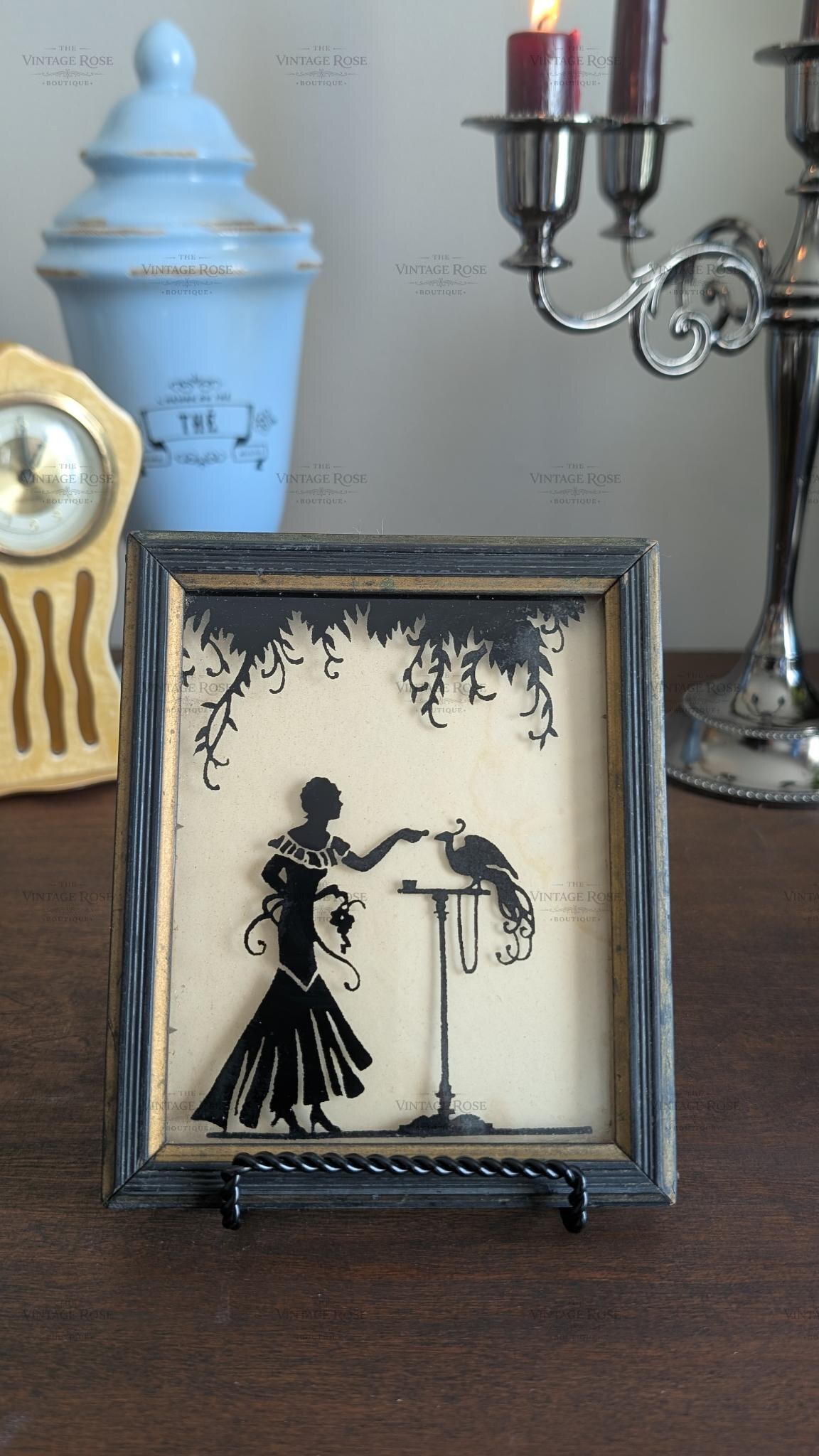
1930s Deltex “Fine Feathers” Reverse Painted Glass Silhouette — Art Deco Lady & Peacock, Brooklyn NY
$32.00Crystal / Glass
HDRA-VR-0003 -
Excellent
Retro (1970s–1990s)
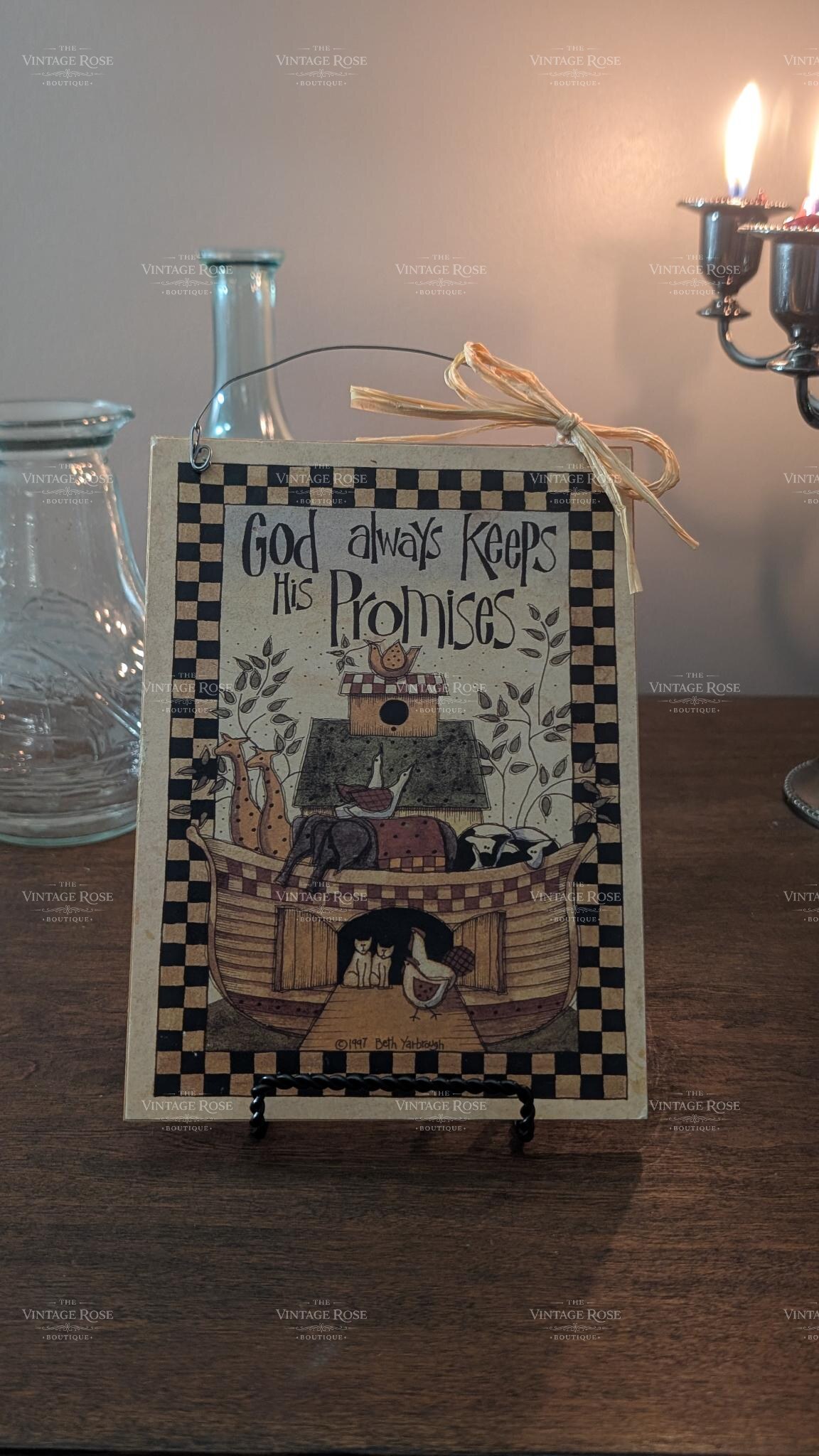
Vintage Beth Yarbrough Folk Art Wall Plaque — “God Always Keeps His Promises” Noah’s Ark Sign, 1997
$24.00Printed illustration on rigid board, wire hanger, raffia bow
HDRA-VR-0007 -
Very Good
Late 20th Century
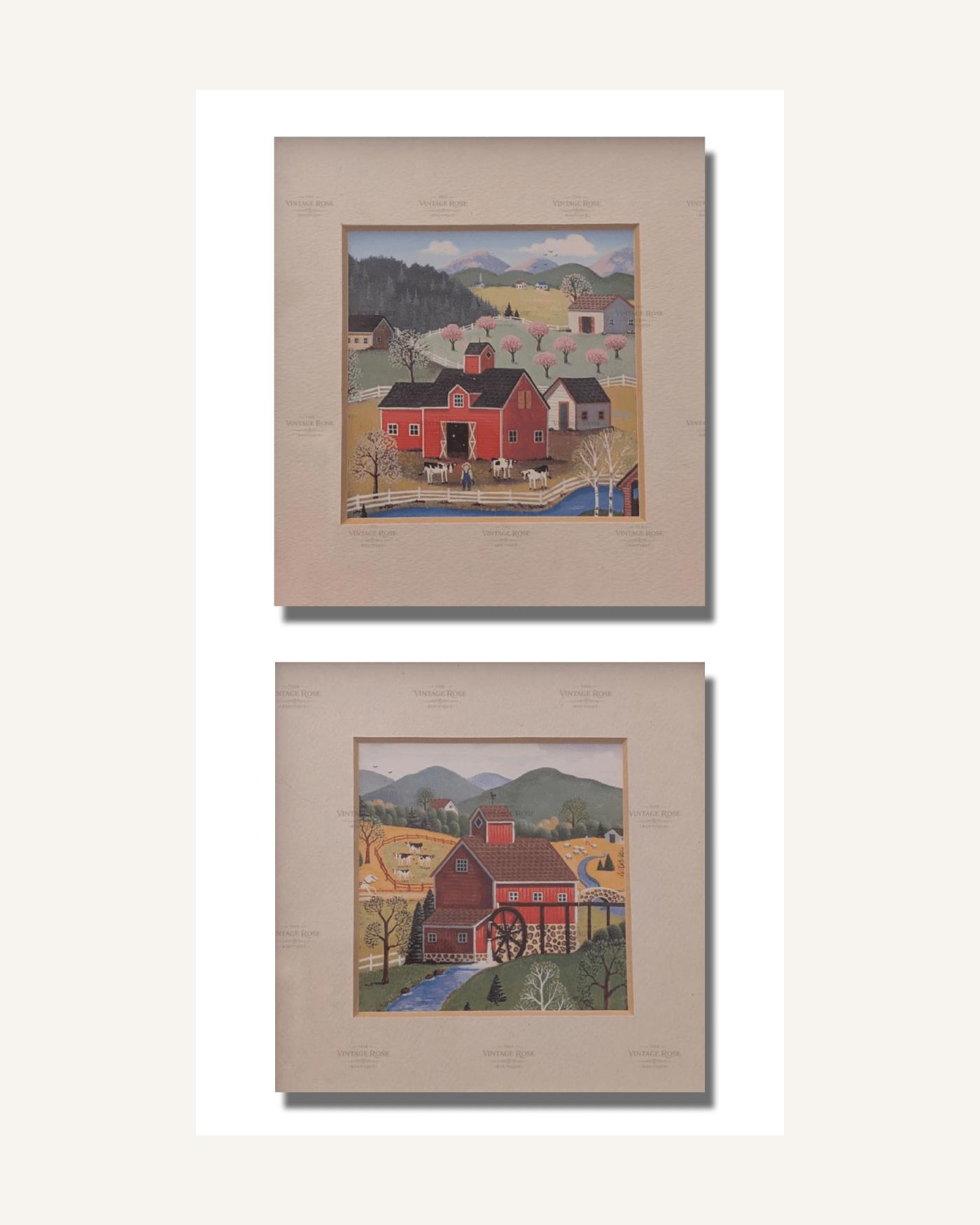
Steven Klein Folk Art Prints, Framed Miniature Pair — “Country Fields” & “Lazy Summer”
$39.00Decorative prints on paper, cream mat board, robin's egg blue painted wood frames, glazed.
HDRA-VR-0006 -
Good
Mid-Century (1940s–1960s)
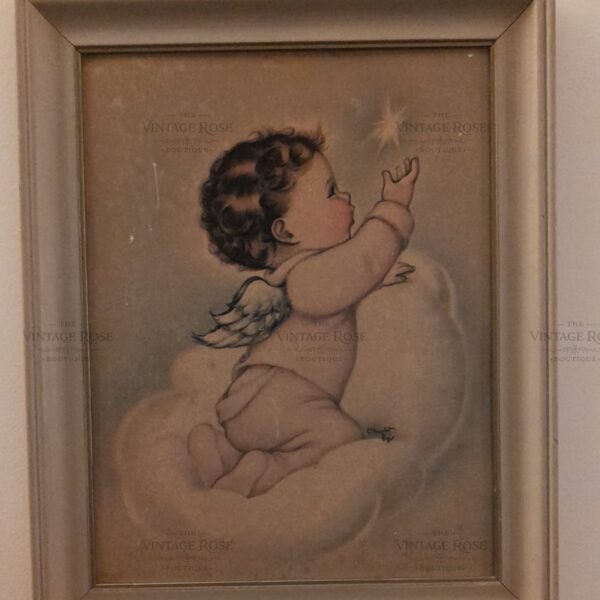
Charlot Byj Cherub Reaching for a Star — Framed Mid-Century Lithograph
$35.00Glass, Paper, Wood
HDRA-VR-0010