Skip to content

Vintage German Porcelain Half-Doll — Marie Antoinette Rococo Court Lady, Arms Away, Hertwig Mold 4344

$90.00 Only one available

Price in USD. Shipping is $5.95 to the contiguous US — see our Shipping Policy.

Art Deco (1920s–1930s) Porcelain / Ceramic Very Good
HDRF-VR-0012
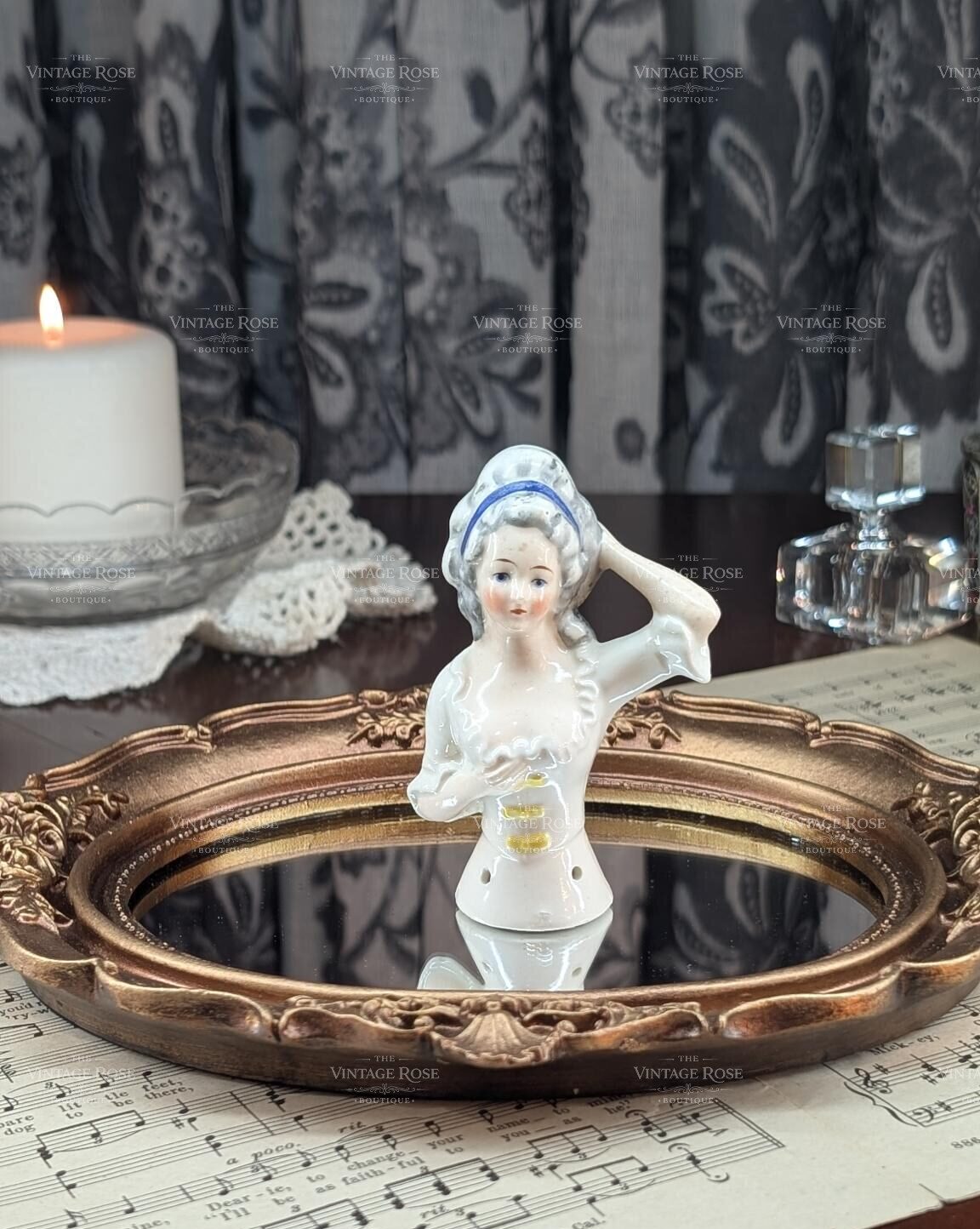
She's the one you've been hoping to find. This vintage German porcelain half-doll depicts a Marie Antoinette-style court lady in full Rococo revival splendor — towering powdered curls threaded with a blue ribbon, low-cut white bodice with gold accents, and a hand-painted face with vivid blue eyes and perfect rosebud lips. Both arms are free from the body in the coveted "arms away" pose: left hand raised behind her head, right hand resting near her chest. This is a significantly more complex form to produce — and to survive a century intact — than the standard "arms in" half-dolls, and collectors price the difference accordingly. The hollow bell-shaped base carries incised mold number "4344" over "Germany," attributing the piece to Hertwig & Co. of Katzhutte, Thuringia — one of the most prolific and respected porcelain factories in the region that invented the art form.

Highlights

  • Vintage porcelain half-doll (pincushion doll) in Marie Antoinette / Rococo court lady form
  • Attributed to Hertwig & Co. of Katzhutte, Thuringia — identified by incised mold number "4344," a recognized Hertwig model known for its grey hair, blue headband, and ruffled detailing
  • German manufacture confirmed by incised "Germany" mark on base — dating the piece to the early 20th century, pre-WWII
  • "Arms away" pose — both arms free from the body, a more complex and desirable form that commands a premium among collectors
  • Elaborate sculpted powdered coiffure with large cascading curls, fully modeled in the round
  • Bright blue ribbon woven through the hair, visible from multiple angles
  • Hand-painted facial features: vivid blue eyes, rosy cheeks, defined brows, small red rosebud lips
  • Low-cut white bodice with ruffled neckline and three gold decorative accents down the center front
  • Hollow, bell-shaped base with sew holes for attachment to a pincushion, powder puff, or boudoir accessory
  • A German "arms away" example with traceable factory provenance — the kind of half-doll a serious collector builds a shelf around

Condition

Very good vintage condition. No chips, cracks, or repairs visible. Both free-standing arms are fully intact — notable for an "arms away" doll, where the extended limbs are vulnerable to breakage over time. Hand-painted details are well-preserved with vibrant color throughout. Some light foxing or age spotting on the skin-tone porcelain areas, consistent with a piece approaching or exceeding a century in age. The incised "Germany" mark and mold number on the base are legible. Sew holes at the base are intact and unobstructed.
Back to Home Decor
Share This Find
Honestly described
Carefully packed
Ships in 2–3 days
$5.95 shipping
Our terms

Vintage German Porcelain Half-Doll — Marie Antoinette Rococo Court Lady, Arms Away, Hertwig Mold 4344

Early 20th Century, Pre-WWII

German Thuringian Porcelain, Rococo Revival Half-Doll


This half-doll carries an incised mold number — "4344" over "Germany" — pressed into the porcelain before firing. The number attributes the piece to Hertwig & Co. of Katzhütte, in Thuringia. Hertwig operated from 1864 through 1941, employing at its peak over nine hundred workers — three to five hundred in the factory, plus another six hundred working from home. Most of the citizens of Katzhütte earned their living from this single enterprise.

The 4344 mold is a recognized Hertwig model, identified by its grey powdered hair, blue headband, and ruffled bodice detailing. The "arms away" pose — both arms free from the body, left hand raised behind the head, right hand at the chest — represents the more complex and desirable form of half-doll construction. Extended limbs are vulnerable to cracking, warping, and breakage during firing, which means fewer were produced successfully, fewer survived the journey from factory to dressing table, and fewer still have made it to the present with both arms intact. This one has.

A traceable mold number from a known Thuringian factory adds a layer of provenance that many half-dolls simply can't offer. Germany — Thuringia in particular — was where the finest examples of the form were made, and Hertwig's work set the standard that Japanese manufacturers later followed.

Materials Glazed porcelain, hand-painted polychrome decoration, sculpted powdered grey-white coiffure with blue ribbon, white bodice with gold accents, hollow bell-shaped base with sew holes, incised mold number "4344" and "Germany" on base
Care Handle by the base — the free-standing arms break invisibly. Dust with a soft brush, especially around the extended limbs. No water or cleaners; the hand-painted decoration is over-glaze. Display on a level surface in a curio cabinet.

Specifications

Dimensions
N/A
Weight
0.5 lbs
SKU
HDRF-VR-0012
If you collect half-dolls with any seriousness, you know there's a distinction the market draws, and it goes like this: Japan made half-dolls. Germany made half-dolls. This is a German one. And you can tell. She's a Marie Antoinette type — not a portrait, exactly, but an evocation. A Rococo court lady in powdered curls and a low-cut bodice, styled after the kind of aristocratic beauty that captured the European imagination for a solid two centuries after the real Marie Antoinette lost her head. The 1920s were particularly taken with the look. Something about the drama of it — the towering hair, the theatrical femininity, the whiff of doomed glamour — suited the decade's taste for decorative excess. Porcelain manufacturers on both sides of the Atlantic produced Rococo revival figures by the thousands, and half-doll makers were no exception. This one, though, isn't a thousand. She's one. And the quality of the modeling makes that clear within about five seconds of picking her up. Start with the hair. It's extraordinary — a massive sculpted coiffure of powdered grey-white curls that cascades past her shoulders, fully modeled in the round. Turn her around and the back is just as detailed as the front, with individual curls and a bright blue ribbon threaded through the whole arrangement. This isn't a flat-backed piece designed to sit against a wall and hope nobody looks too closely. Someone sculpted every angle, which means someone expected every angle to be seen. The face is hand-painted with real precision: vivid blue eyes, defined brows, rosy cheeks, and a small red rosebud mouth. The bodice is white with a delicate ruffle at the neckline and three gold accents running down the center front — likely representing decorative bows or buttons in the 18th-century style. It's a restrained palette that lets the sculpting do the talking, which is the right call when the sculpting is this good. And then there are the arms. Both of them are free from the body — the left raised behind her head in that classic coquettish gesture, the right resting near her chest. Collectors call this the "arms away" form, and it matters. An "arms in" doll — where the arms are molded flat against the torso — is essentially a single solid piece. An "arms away" doll has open space between the limbs and the body, which means the arms had to be formed separately or at least left unsupported during firing. Porcelain is unforgiving in the kiln. Thin, extended elements like free-standing arms are far more likely to crack, warp, or break during the firing process. So fewer were made successfully, fewer survived the journey from factory to vanity table, and fewer still have made it to the present with both arms intact. This one has. That's not nothing. Turn her over and you'll find the mark that collectors look for first. Incised into the back of the hollow base — pressed into the porcelain before firing — are two marks: the mold number "4344" above the word "Germany." The mold number attributes this piece to Hertwig & Co., the prolific porcelain factory based in Katzhutte, in the Thuringian region of Germany. Hertwig operated from 1864 through 1941, employing at its peak over 900 workers — 300 to 500 in the factory itself, plus another 600 working from home. Most of the citizens of Katzhutte earned their living from this single enterprise. The 4344 mold is a recognized Hertwig model, frequently identified by its grey powdered hair, blue headband, and ruffled detailing — precisely the features we see here. Hertwig didn't stamp their company name on most pieces — just the mold number and country of origin, which is why identification depends on matching the number to known factory records. The "Germany" mark without "Made in" is generally associated with pieces produced before the early 1930s, when U.S. import regulations tightened. Combined with the Rococo revival styling and Hertwig's known production timeline, this places her comfortably in the early 20th century — the golden age of half-doll production. Germany, and Thuringia in particular, was the birthplace and beating heart of the half-doll tradition. Factories like Dressel & Kister, Goebel, Galluba & Hofmann, and Hertwig produced the finest examples of the form, and their work set the standard that Japanese manufacturers later followed. Having a piece with a traceable mold number from a known Thuringian factory adds a layer of provenance that many half-dolls simply can't offer. The base is hollow and bell-shaped, with at least three visible sew holes around the lower edge — the functional detail that identifies this as a true pincushion or boudoir accessory doll. Thread or wire would have passed through these holes to secure her to a silk pincushion, powder puff, tea cozy, or any of the other useful-beautiful objects that women kept on their dressing tables. Whether she ever sat atop one or spent her life as a standalone figure, we can't say. She stands beautifully on her own either way. We won't pretend to be objective about this one. A German "arms away" example from a known Thuringian factory, with this level of sculptural detail, intact arms, and legible provenance marks — this is the kind of half-doll a serious collector builds a shelf around. As the old collectors' saying goes: buy the best you can find, not the most you can carry. This is the best we've found.

Details

  • Type: Porcelain half-doll (pincushion doll / boudoir figurine)
  • Subject: Marie Antoinette / Rococo revival court lady
  • Material: Glazed porcelain, hand-painted
  • Colors: White bodice with gold accents; powdered grey-white hair with bright blue ribbon; hand-painted facial details with vivid blue eyes, rosy cheeks, and rosebud lips
  • Pose: "Arms away" — left arm raised behind head, right hand at chest; both arms free from the body
  • Base: Hollow, bell-shaped, with sew holes for pincushion or accessory attachment
  • Marks: Incised mold number "4344" over "Germany" on back of base
  • Attribution: Hertwig & Co., Katzhutte, Thuringia, Germany — identified by mold number 4344
  • Era: Early 20th century, pre-WWII — dating based on "Germany" mark style and Hertwig production timeline (1864–1941)
  • Origin: Germany — confirmed by incised "Germany" mark on base
  • Size: Approximately 4 inches tall (half-doll only, without pincushion body)

Condition

Very good vintage condition. No chips, cracks, or structural repairs visible. Both free-standing "arms away" limbs are fully intact — a significant detail, as these extended elements are the most vulnerable to damage over a piece's lifetime. Hand-painted details are well-preserved with vibrant color on the face, bodice, and hair ribbon. Some light foxing or age spotting is present on the skin-tone porcelain areas, which is common and expected in pieces of this age. The incised "Germany" mark and mold number "4344" on the base are legible. Sew holes at the base are intact and unobstructed. All original — no restoration or touch-up work detected.