 Vintage Inspired
1 / 2
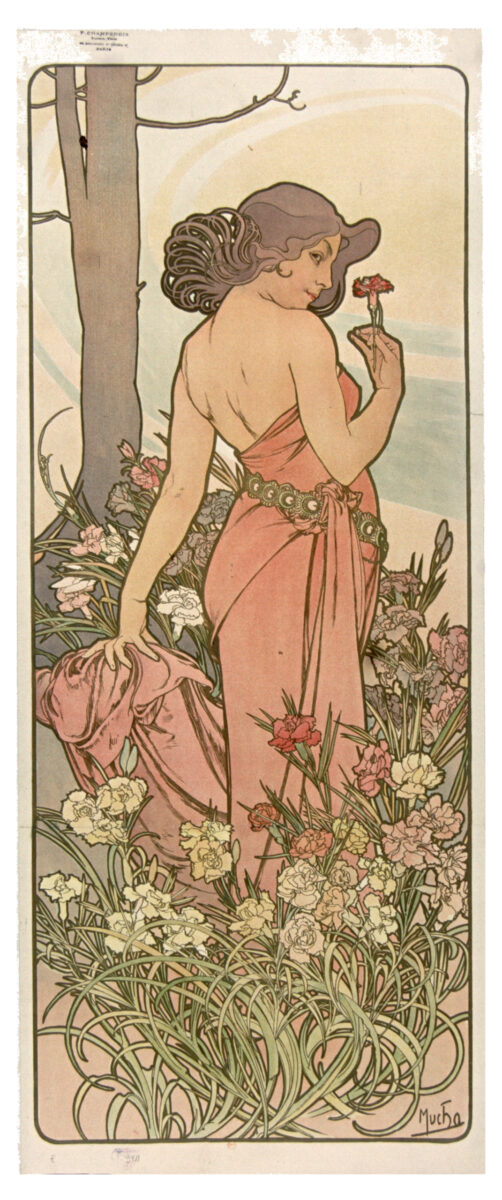
Alphonse Mucha — Carnation (1898) — Art Nouveau Print on Hahnemühle
This is a contemporary piece, curated for its vintage character.
Price in USD. Shipping is $10.95 to the contiguous US — see our Shipping Policy.
Alphonse Mucha — Carnation (1898) — Art Nouveau Print on Hahnemühle
1898 — Belle Époque
French Art Nouveau
Alphonse Mucha (1860–1939) was Czech by birth, Parisian by formation, and by 1898 the most reproduced poster artist in Europe. His Les Fleurs series — La Rose, L'Iris, L'Œillet, and Le Lys — was made not for galleries but for popular consumption, printed in editions of thousands by F. Champenois of Paris and sold at prices working-class Parisians could afford. Mucha had a deliberate philosophy about ordinary homes deserving beauty, and Les Fleurs is the most ambitious expression of it.
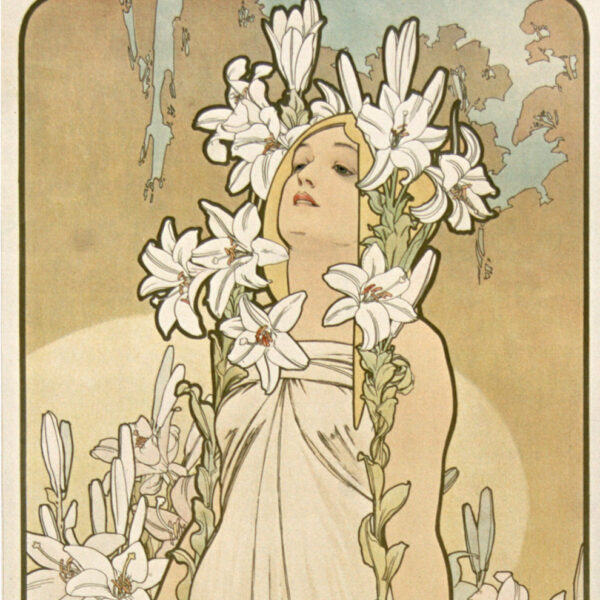
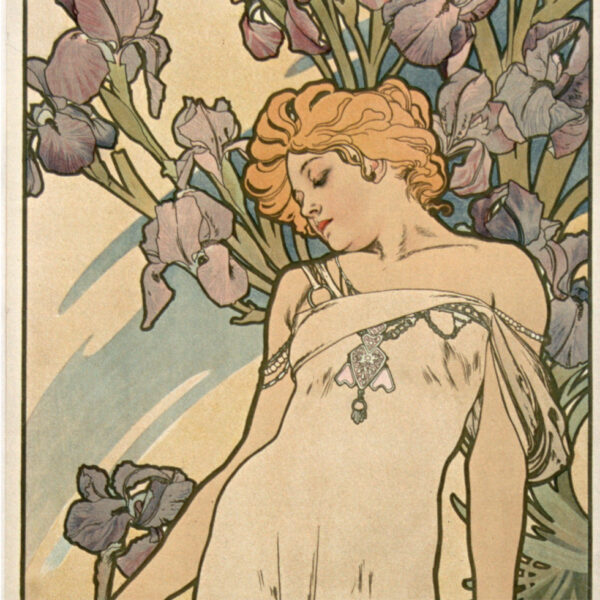
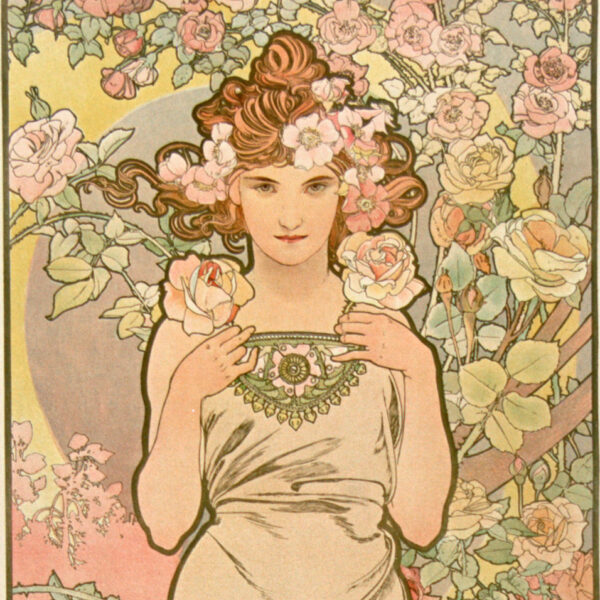
Each of the four panels pairs a young woman with her flower, framed by ornamental vines and set against a luminous halo — the visual grammar that came to define Art Nouveau. The series is one of the most enduring statements of decorative printmaking from the Belle Époque.
L'Œillet is the curious one: turned away from the viewer in a coral-pink gown, leaning toward a single carnation held at her lips, with a dense bed of carnations at her feet.
This reproduction is drawn from the Bibliothèque nationale de France's high-resolution scan of the 1898 Champenois printing. The Champenois imprint at the top, the artist's signature, and the BnF dépôt légal stamp are preserved on the print — marking its path from a Paris print shop, through a national library's archive, to a contemporary wall.
Specifications
- Dimensions
- 41 × 3 × 3 in
- Weight
- 1.2 lbs
- SKU
- HDRA-VI-0003
Source and provenance
This reproduction is taken directly from the Bibliothèque nationale de France, which holds an 1898 original printed by F. Champenois of Paris — Mucha's exclusive printer for the Les Fleurs series. The Champenois imprint at the top of the print and the BnF deposit stamp at the bottom are preserved on the reproduction, not removed. Most reproductions strip these marks out. We don't, because they are part of what the object actually is: a documented passage from a Paris print shop in 1898, through a national library's archive, to the wall it eventually finds.Paper
The print is produced on Hahnemühle German etching paper, 310 gsm — a heavyweight cotton-based fine art paper from the German mill that has been making archival paper since 1584. Its slight surface tooth honors the lithographic tradition the original print emerged from, and it is the paper of choice for museum and gallery reproductions of historical lithographs. Printing is done with archival pigment inks intended to hold their color for a century or more under reasonable framing conditions.Size and proportions
The print measures 16.1 × 38.4 inches (40.8 × 97.5 cm), reproducing Mucha's original 1:2.45 panel proportions rather than cropping the composition to fit a more common rectangle. The image carries a small white border on all sides, so that a framing mat can be added without covering the artwork or its provenance marks.Framing
The dimensions fit cleanly inside a standard 16 × 40 inch frame with a small mat — a configuration available at most frame retailers (Michael's, Frame Destination, and similar) and conventional for matted fine art presentation. A mat is recommended; the print can also be framed flush against the glass without one. L'Œillet is one of four panels in Mucha's Les Fleurs series. Her companions — La Rose, L'Iris, and Le Lys — are offered separately in the collection.Related products
-
 Vintage Inspired
New
Belle Époque (1871–1914)
Alphonse Mucha — Lily (1898) — Art Nouveau Print on Hahnemühle
$89.00Paper
HDRA-VI-0004 -
Vintage Inspired
New
Belle Époque (1871–1914)
Alphonse Mucha — Iris (1898) — Art Nouveau Print on Hahnemühle
$89.00Paper
HDRA-VI-0002 -
Vintage Inspired
New
Belle Époque (1871–1914)
Alphonse Mucha — La Rose (1898) — Art Nouveau Print on Hahnemühle
$89.00Paper
HDRA-VI-0001