Skip to content

Vintage Porcelain Half-Doll — Rococo Court Lady with Powdered Coiffure, Pincushion Figurine, Japan

$32.00 Only one available

Price in USD. Shipping is $5.95 to the contiguous US — see our Shipping Policy.

Art Deco (1920s–1930s) Porcelain / Ceramic Good
HDRF-VR-0010
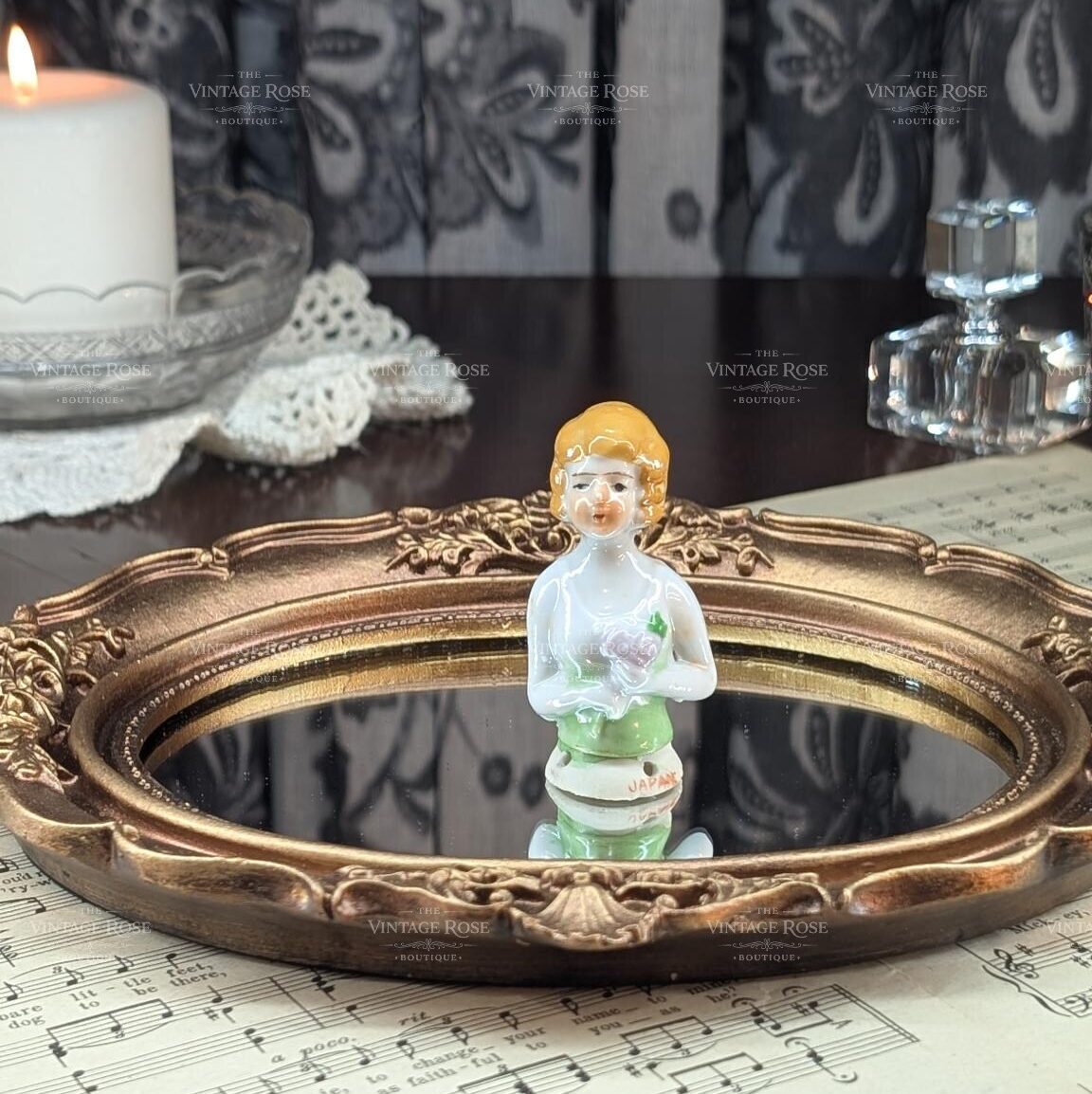
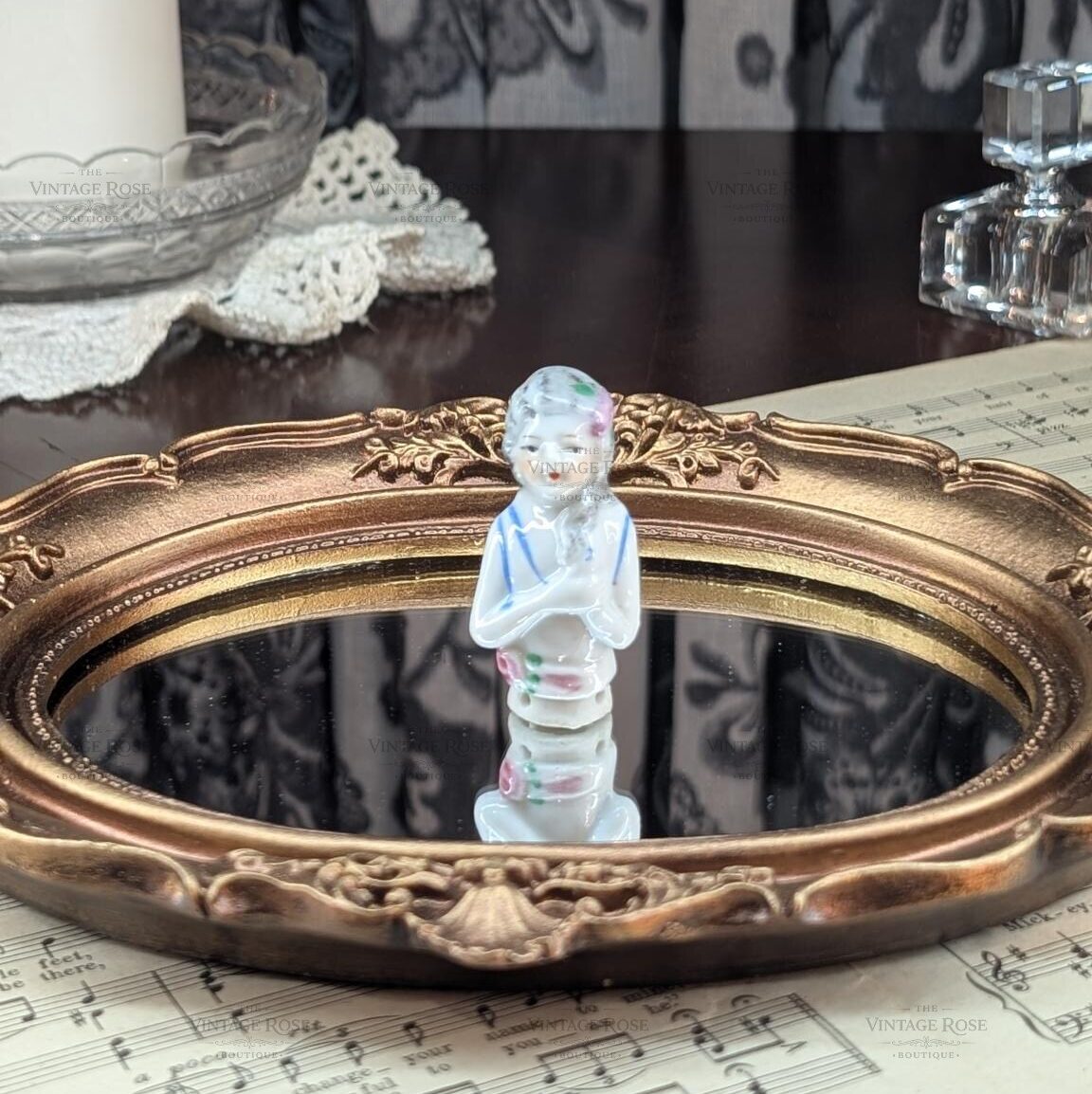
She's a court lady — and once you see it, you can't unsee it. This vintage Japanese porcelain half-doll depicts a Rococo-style figure in the Marie Antoinette tradition: grey powdered hair swept up in a tall, sculpted coiffure with a pink rose and green leaves tucked in at the side, a white bodice crossed by blue diagonal sash lines forming a bold V-shape, and another pink rose accent at the waist. The hand-painted face — dark eyes, rosebud lips, rosy cheeks, defined brows — has the composed, unhurried expression of someone who knows exactly where she belongs in the room. The powdered hair is the tell. This isn't a simple updo or bun — it's a fully sculpted 18th-century coiffure, modeled in the round with detail continuing across the back. The same convention appears on German Rococo revival half-dolls from the same era: the towering powdered hair, the roses woven in, the aristocratic bearing. Japanese porcelain manufacturers of the interwar period studied those German originals closely and produced their own interpretations, often with simpler construction but unmistakable character. This is one of those pieces — a Japanese reading of a European court lady, with all the charm of the original and a personality entirely her own. The blue diagonal lines on the bodice read as stylized ribbon or sash detail — a common feature on Rococo-era costumes, where wide silk sashes and decorative ribbons crossed the bodice. Combined with the roses in the hair and at the waist, the palette is deliberate and coordinated: blue, pink, green, and white, the colors of a porcelain shepherdess or court portrait. The "arms in" pose keeps both hands clasped demurely at the waist, and a solid round base with sew holes confirms her original purpose as the crown of a pincushion, powder puff, or boudoir accessory. "JAPAN" is incised boldly and clearly into the base — placing her in the interwar export period, circa 1921–1941.

Highlights

  • Vintage porcelain half-doll (pincushion doll) in the Rococo court lady / Marie Antoinette tradition
  • Grey powdered hair in a tall, sculpted 18th-century coiffure — fully modeled in the round, with detail continuing across the back
  • Pink rose with green leaves in the hair and a second pink rose accent at the waist — the floral conventions of Rococo court lady figurines
  • White bodice with blue diagonal sash or ribbon lines forming a distinctive V-shape — a stylized Rococo costume detail
  • Hand-painted facial features: dark eyes, rosy cheeks, rosebud lips, defined brows
  • "Arms in" pose — hands clasped demurely at the waist
  • Japanese manufacture confirmed by bold, clearly incised "JAPAN" mark on base — dating the piece to circa 1921–1941
  • Solid round base with sew holes for attachment to a pincushion, powder puff, or boudoir accessory
  • A Japanese interpretation of the European Rococo court lady form — the same character type produced by German factories like Hertwig, rendered here with Japanese craftsmanship and its own distinct charm

Condition

Good vintage condition. No chips, cracks, or repairs. Hand-painted details are well-preserved with clean color on the face, sash lines, and rose accents. Minor wear on the base consistent with age. The incised "JAPAN" mark is bold and fully legible. Sew holes at the base are intact and unobstructed.
Back to Home Decor
Share This Find
Honestly described
Carefully packed
Ships in 2–3 days
$5.95 shipping
Our terms

Vintage Porcelain Half-Doll — Rococo Court Lady with Powdered Coiffure, Pincushion Figurine, Japan

Circa 1921 – 1941

Interwar Japanese Export Porcelain, Rococo Revival Half-Doll


This half-doll belongs to one of the most recognizable character types in the porcelain figurine tradition: the Rococo court lady. The grey powdered coiffure — tall, sculpted, modeled in the round with detail continuing across the back — is the defining tell. It references the towering hairstyles of eighteenth-century European courts, the same silhouette made iconic by Marie Antoinette and rendered in porcelain by German factories throughout the 1920s.

Japanese porcelain studios of the interwar period studied those German originals closely and produced their own interpretations for the American export market. This example bears a bold, clearly incised "JAPAN" mark on the base — pressed into the porcelain before firing. The simple "JAPAN" wording dates the piece to between 1921 and 1941, when U.S. customs law required country-of-origin marks on imports.

Blue diagonal lines crossing the white bodice are a stylized sash detail drawn directly from Rococo court dress, where wide silk ribbons defined the formal silhouette. Pink roses appear in the hair and at the waist — the traditional floral accents of the court lady form. The face is painted with composure and precision: dark eyes, defined brows, rosy cheeks, and a small rosebud mouth. The "arms in" pose and solid base with sew holes confirm her original purpose atop a pincushion or boudoir accessory.

Materials Glazed porcelain, hand-painted polychrome decoration, sculpted powdered coiffure with molded rose detail, solid round base with sew holes, incised "JAPAN" country-of-origin mark
Care Handle by the base — the sculpted coiffure and molded rose are the most vulnerable areas. Dust with a soft brush. No water or cleaners on over-glaze painting. Display away from direct sunlight.

Specifications

Dimensions
N/A
Weight
0.5 lbs
SKU
HDRF-VR-0010
Every half-doll has a character type, and this one has been hiding hers in plain sight. Look at the hair. That's not a simple bun or updo — it's a powdered Rococo coiffure, sculpted tall and swept up in the 18th-century manner, with every curve of the hairstyle continuing in full detail around the back of the piece. A pink rose with green leaves is tucked into the right side, exactly where you'd find a floral accent on a court portrait or a porcelain shepherdess. This is the same visual language that German factories used on their Marie Antoinette half-dolls throughout the 1920s: the towering powdered hair, the roses, the aristocratic bearing. The Japanese manufacturer who made this piece knew exactly what they were referencing. Now look at the bodice. Those blue diagonal lines crossing the white porcelain from each shoulder, meeting in a V at the center — the original listing called them "stripes," but they make much more sense as a stylized sash or ribbon detail. Rococo court dress was defined by wide silk ribbons, decorative sashes, and diagonal trim across fitted bodices. The blue lines here are the simplified version of that convention, painted with clean precision on a piece barely three inches tall. Combined with the pink rose accent at the waist, the whole costume reads as a court lady's ensemble: formal, deliberate, and unmistakably 18th century in inspiration. The face is hand-painted with a steady hand — dark eyes, defined brows, rosy cheeks, and a small rosebud mouth. The expression is composed and self-possessed, not coy or flirtatious. She knows who she is. And what she is, specifically, is a Rococo revival court lady — one of the standard character types that porcelain manufacturers produced throughout the interwar period. German factories like Hertwig, Dressel & Kister, and Goebel made elaborate versions with "arms away" poses and hollow bases. Japanese factories watched, learned, and produced their own interpretations: simpler in construction, with arms molded close to the body and solid bases, but often with surprising character and charm. This is one of those Japanese interpretations, and it's a particularly good one. The "arms in" pose — both hands clasped demurely at the waist — is the more common construction method. Without the structural risk of free-standing limbs, these pieces survived the kiln and the century more reliably. But the trade-off was never about quality of character. Some of the most expressive half-dolls ever made are "arms in," and this one has a presence that exceeds her size. Turn her over and you'll find "JAPAN" incised boldly into the base — not painted, not stamped, but pressed into the porcelain before firing. The incision is clean and deeply cut, fully legible without any squinting. The "JAPAN" mark (as opposed to "Nippon" or "Made in Japan") is the interwar shorthand, dating the piece to the export period between 1921 and 1941. Japanese porcelain factories during this era produced enormous quantities of decorative figures for the Western market, including half-dolls that closely followed European models. The best of them — and this is one of the best — brought something of their own to the form: a certain delicacy in the painting, a particular way of interpreting European glamour through a Japanese lens. The solid round base includes sew holes around the lower edge — the functional detail that identifies this as a true pincushion or boudoir accessory doll. Whether she ever sat atop a silk pincushion on someone's vanity or spent her decades as a display piece, we can't say. Either role suits her. If you've been looking for a Rococo court lady half-doll without the German price tag, this is your piece. She has the powdered coiffure, the roses, the diagonal sash, the aristocratic bearing — all the elements that define the type. What she doesn't have is the pretension. She's a Japanese court lady who knows she's not German, doesn't care, and looks stunning anyway.

Details

  • Type: Porcelain half-doll (pincushion doll / boudoir figurine)
  • Subject: Rococo court lady in the Marie Antoinette tradition
  • Material: Glazed porcelain, hand-painted
  • Colors: White bodice with blue diagonal sash/ribbon lines; pink roses with green leaves in hair and at waist; grey powdered coiffure; hand-painted facial details with rosy cheeks and rosebud lips
  • Pose: "Arms in" — arms molded close to the body, hands clasped at waist
  • Base: Solid, round, with sew holes for pincushion or accessory attachment
  • Era: Circa 1921–1941, interwar period — dating based on incised "JAPAN" mark
  • Origin: Japan — confirmed by bold, clearly incised "JAPAN" mark on base
  • Size: Approximately 3 inches tall (half-doll only, without pincushion body)

Condition

Good vintage condition. No chips, cracks, or repairs visible. Hand-painted details are well-preserved — blue sash lines remain crisp, rose accents retain good color, and facial features are clean and legible. The grey powdered coiffure shows excellent sculptural detail in the round. Minor wear on the base consistent with age and handling. The incised "JAPAN" mark on the base is bold and fully legible — no ambiguity. Sew holes at the base are intact and unobstructed. All original — no restoration or touch-up work detected.